Structural Drying & Dehumidification in Union City, CA
Detached houses, apartments and mobile homes dry differently, and Union City has all three. The drying team sets air movers and LGR dehumidifiers to each structure and runs them until meters agree.
(888) 774-9605Call Union City dispatch for a moisture map- IICRC S500 drying
- Daily moisture readings
- Truck-mounted extraction
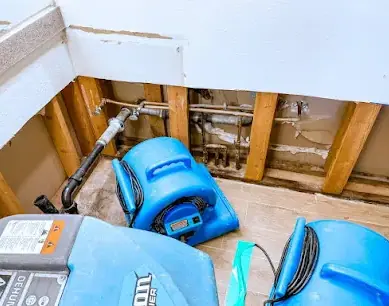
First steps for structural drying in Union City
- 1
Stop the source
Make sure the leak or flooding has stopped before any drying plan is set.
- 2
Clear the floor
Lift rugs, furniture and boxes off wet surfaces so air can reach them.
- 3
Leave surfaces open
Do not close up baseboards, cabinets or panels over damp areas, since trapped moisture lingers.
- 4
Request a moisture map
Call for readings that show where the wet material is and what equipment it needs.
How structural drying is handled in Union City
What separates a finished dry-out from a cosmetic one is the order of the work and the readings behind it.
Dispatch always on
Drying starts best right after extraction, and Union City dispatch is open at every hour.
The S500 target
IICRC S500 sets the drying goal, and the readings, not a calendar, decide when the equipment leaves.
Daily proof
Each day's temperature, humidity and moisture readings are logged, which gives an insurer a clear record.
Varied structures
Detached homes, apartments and mobile homes each need a different drying plan, and Union City has all three.
What does structural drying cost in Union City, CA?
Structural drying and dehumidification in Union City, CA usually runs $1,000 to $6,500 or more. The total depends on the number of rooms, the class of loss, the materials involved and how many days the equipment has to run.
The drivers are the water category, the square footage that got wet, the material class and how fast drying started. Try the water damage cost calculator for a planning range, then call for a firm number.
A single area, light loss
$1,000 to $2,500- Fans and one LGR unit
- A moisture map
- Daily logs
Several rooms
$2,500 to $4,500- Wall cavities vented
- Added equipment
- Psychrometric readings
Dense materials, Class 4
$4,500 to $6,500+- Hardwood, plaster or concrete
- Desiccant dehumidifiers
- Long monitoring
How structural drying moves from wet to dry
- 1
Map and classify
The tech measures moisture and sets the class of loss, so the equipment can be matched to the water load.
- 2
Open the paths
Baseboards, cabinet bases and wall ports are opened so dry air can reach the wet cavities.
- 3
Run the gear
Air movers circulate air and LGR dehumidifiers pull moisture out, with desiccants added for dense materials.
- 4
Log and verify
Temperature, humidity and moisture readings are recorded daily until materials sit within 2 to 4 points of dry.
Structural drying is the long middle of nearly every water loss. After the water is extracted, moisture still sits in framing, subfloor, drywall and cabinets, and it has to be drawn out gradually and measured along the way.
Different structures, different drying plans
About 58.3% of Union City housing units are detached single-family homes, 11.3% are attached and 17.1% are in buildings of 5 or more units. Another 1,237, about 6.0%, are mobile homes, whose floors and wall cavities are built lighter than a site-built house, so openings and equipment are chosen to suit.
- Detached homes often need ports and vents through several wall cavities
- Shared-wall buildings call for drying from both sides of a party wall
- Mobile homes need gentler openings and attention to the floor system
- Dense materials such as hardwood or plaster may need desiccant units
How the equipment does its work
Each machine has a job, and the placement is planned room by room:
- Air movers sweep dry air across wet surfaces so the water leaves them
- LGR dehumidifiers pull that moisture out of the air and drain it away
- Wall ports and opened baseboards let air reach the cavity behind the drywall
- Thermal imaging and pin meters check progress without extra demolition
- Readings for temperature, humidity and moisture go in the log every day
Drying works because warm, dry, moving air takes water from materials, and a closed, humid room defeats it. That is why the work follows water extraction in Union City, which removes the liquid first.
Water gone but walls and floors still damp? Get a moisture map before anything is closed up.
Call (888) 774-9605 about structural drying in Union CityKnowing when the job is done
Surfaces can feel dry while framing is still wet, so the finish is a number, not a feeling. Equipment comes out when wet materials read within a few points of a dry sample from elsewhere in the home. A concrete floor after a leak, as covered in slab leak water damage in Union City, is often the last material to reach that target.
The daily log is also the insurance record. Coverage depends on the policy, so check the details with your insurer.
Covering every corner of Union City, CA
The restoration team covers Union City ZIP code 94587, from Decoto and Old Alvarado to the Station District and the Union Landing area.
See every area servedStructural Drying and Dehumidification questions in Union City, CA
What does dried to standard mean?
It means wet materials read within a few points of a dry sample from the same home, as set by IICRC S500. The goal is a measured number, never how a surface feels.
Why not just run household fans?
A fan moves air but does not remove moisture from it, so humidity climbs and walls stay wet. Dehumidifiers pull the water out, which is what actually dries the structure.
How long does structural drying take?
A small loss may need only a few days, while dense materials or several rooms take longer. Equipment stays until the readings reach the goal, not for a set number of days.
Can the equipment be shut off at night?
It should keep running. Stopping it lets humidity rebound and slows progress, so the machines stay on until the drying team measures the goal and removes them.
Why are small holes drilled into walls?
Wet cavities behind drywall cannot dry through the surface. Small ports let air flow in, and they are easy to patch once the readings are in range.
What makes an LGR dehumidifier different?
An LGR unit, short for low grain refrigerant, pulls much more moisture from humid air than a household unit. That is what makes it the standard tool for water-damaged structures.
Walls and floors still wet in Union City? Start drying now.
Moisture inside framing and flooring keeps spreading until it is measured and dried. The Union City restoration team dispatches 24/7.