Structural Drying & Dehumidification in Dublin, CA
Water left in framing, subfloor and walls is what causes swelling and odor later. The drying team dries the structure to a measured goal, not just the surface.
(888) 774-9605Speak with 24/7 Tri-Valley dispatch- IICRC S500 drying
- Daily moisture readings
- Truck-mounted extraction
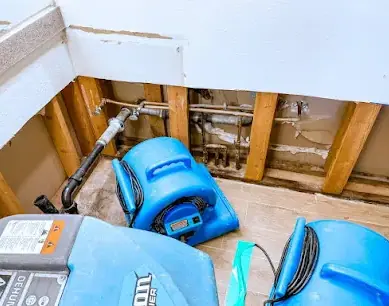
First steps for structural drying in Dublin
- 1
Stop the source
Make sure the leak is stopped and no new water is coming in.
- 2
Lift and clear
Move furniture and rugs off wet floors and away from the walls.
- 3
Do not seal it in
Hold off on paint, new flooring or baseboard until readings say dry.
- 4
Call for a moisture map
Call to have walls, floors and ceilings measured.
How structural drying is handled in Dublin
What separates a finished dry-out from a cosmetic one is the order of the work and the readings behind it.
Rapid local response
The Dublin restoration team runs 24/7 dispatch, so extraction starts while the damage is still small.
IICRC S500 drying standard
IICRC S500 is the industry drying standard. Crews dry the structure, not just the surface, and pull equipment only on readings.
Claim-ready documentation
A moisture map, daily psychrometric logs and timestamped photos taken before any demolition go into the claim file.
Tri-Valley water experts
Slab leaks on valley clay, stacked condo leaks and atmospheric river storms are the everyday work in Dublin.
What does structural drying cost in Dublin, CA?
In Dublin, CA, structural drying and dehumidification typically runs $1,000 to $6,500 or more, depending on the number of rooms, the class of loss, the materials involved and how many days the equipment has to run.
The drivers are the water category, the square footage that got wet, the material class and how fast drying started. Try the water damage cost calculator for a planning range, then call for a firm number.
Class 1 or 2, one area
$1,000 to $2,500- Air movers and LGR dehumidifier
- Moisture map
- Daily logs
Several rooms
$2,500 to $4,500- Wall cavities vented
- More equipment
- Daily psychrometric readings
Class 4 materials
$4,500 to $6,500+- Hardwood, plaster or slab
- Desiccant dehumidifiers
- Extended monitoring
How structural drying moves from wet to dry
- 1
Moisture map first
The tech who does the walkthrough maps moisture with thermal imaging and pinless meters before any equipment goes down.
- 2
Extract and remove
The extraction crew pulls standing water with truck-mounted extraction, then removes porous material the water has ruined.
- 3
Set the drying plan
The drying team sets air movers and LGR dehumidifiers to each room's evaporation load and class of loss.
- 4
Read daily, document
The drying team logs readings every day until the wet material sits within 2 to 4 points of a dry reference, then the equipment comes out.
Structural drying is the part of a water loss that takes the most time and gets skipped most often. Mopping and a few fans make a room look dry while the bottom of the drywall, the framing and the subfloor or slab are still wet. The drying team's job is to remove that hidden water and prove it is gone.
What the drying team measures
- Moisture content of drywall, wood framing, subfloor and concrete with pin and pinless meters
- Temperature and relative humidity in each room, converted to grains per pound
- A dry reference reading from an unaffected part of the same home
- Thermal images that show cool, wet areas behind walls and ceilings
Class 1 through 4 sets how much equipment a room needs. Class 1 is a small area with low-porosity materials. Class 4 means dense materials like hardwood, plaster or concrete that hold water tightly, which can call for desiccant dehumidifiers.
How a structure is dried
- Removal of wet materials that cannot be saved, so the rest can dry
- Air movers along walls and across floors, set to each room's evaporation load
- LGR dehumidifiers pulling water out of the air, with desiccants for Class 4 materials
- Baseboard off and small vent holes into wall cavities when needed
- Daily logs until materials sit within 2 to 4 points of the dry reference
Dublin's dry summers help, and wet winters slow things down. On a cool, damp January day the dehumidifiers work harder than in August, which is one reason the drying team pulls equipment on readings, not on a schedule. The drying-time estimator gives a rough planning range.
Floor looks dry but the room still smells damp? Get the walls and subfloor measured.
Call (888) 774-9605 for structural drying in DublinWhy drying logs matter
Daily psychrometric readings and moisture logs show an adjuster that the job met the standard and that the equipment was needed for each day it ran. They also protect the home, because reconstruction should not start until the structure reads dry. The EPA explains why drying within 24 to 48 hours matters, and the U.S. Department of Energy covers how humidity behaves inside a home.
Covering every corner of Dublin, CA 94568
The restoration team covers West Dublin, Downtown Dublin and the East Dublin neighborhoods along Tassajara Road, with nearby Pleasanton, San Ramon and Livermore close at hand.
See every Dublin neighborhood coveredStructural Drying and Dehumidification questions in Dublin, CA
What does dried to standard mean?
It means wet materials have been dried to within 2 to 4 points of a dry reference material in the same building, measured with meters, following the IICRC S500 approach.
Why not just use household fans?
Fans move air but do not remove water from it. Without dehumidification, moisture moves from the walls into the air and back into other materials.
How long does structural drying take?
A contained Class 1 loss usually dries in three to five days. Hardwood, plaster, concrete and stacked condo ceilings take longer.
Can the equipment be turned off at night?
It is best to leave it running. Turning it off lets the humidity climb again and adds days to the job.
Why are holes drilled in the wall?
Small holes behind the baseboard let dry air into wall cavities, so the framing can dry without removing full sheets of drywall.
What is an LGR dehumidifier?
A low grain refrigerant dehumidifier pulls more water from the air than a standard unit, even as the air gets drier, which is why restoration crews use them.
Water damage in Dublin? Get the drying started today.
Every hour of standing water reaches more drywall, cabinetry and subfloor. The Dublin restoration team dispatches 24/7.