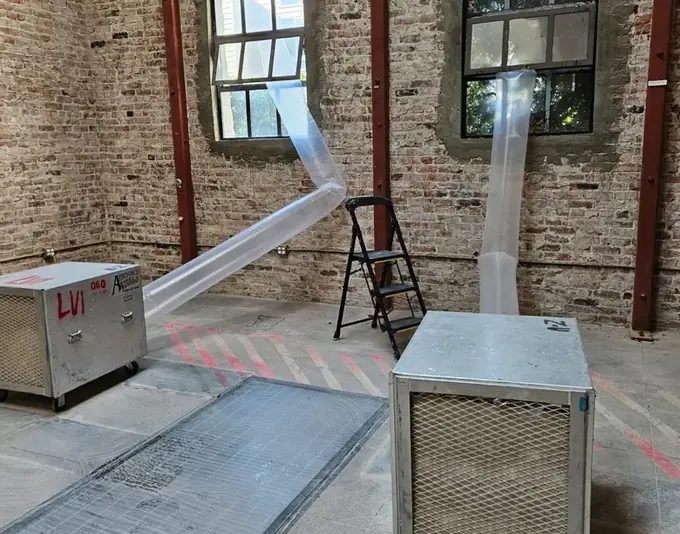
Pleasanton has a mix of business space that few cities match: Hacienda Business Park, Stoneridge Shopping Center and the shops of downtown Main Street. A water loss in any of them stops work, and the clock runs against the business.
Key takeaways
- Hacienda Business Park spans 875 acres with about 630 companies and 16,000 employees, so many losses involve shared buildings and several tenants.
- Stoneridge Shopping Center has over 125 stores and large areas of surface parking, and downtown Main Street has older storefronts.
- Stop the water, protect inventory and records, and call the property manager and the insurer early.
- The restoration team extracts water, dries structure and contents, and works around business hours where it can.
- Daily moisture logs and photos are the paperwork the insurer will ask for.
Three kinds of business space
Pleasanton's commercial buildings are not all alike, and the type of space shapes the loss.
A homeowner's rules do not apply here. A business has tenants, landlords, shared walls and neighbors on every floor.
Each kind of space needs a different plan for access, noise and timing.
Hacienda Business Park
Hacienda spans 875 acres with over 10 million square feet and about 630 companies, with about 16,000 employees.
Many offices share a building, so a leak on one floor can reach another tenant's suite.
Stoneridge Shopping Center
Stoneridge has over 125 stores and large areas of surface parking.
Stores sit side by side, so a sprinkler or supply failure in one store can affect the floor and walls of the next.
Downtown Main Street
Main Street shops sit in older buildings. The Kolln Hardware building on Main Street was built in 1890, and downtown has 91 historic residential properties nearby.
Older construction can hide water in wall cavities and under old flooring.
Common causes of a business water loss
Commercial losses come from many sources. Some are the same as at home, and some are not.
A small leak above a ceiling can run for days before anyone sees a stain, so the first sign is often a sagging ceiling tile or a damp smell.
- A burst supply pipe or a failed fitting above a ceiling.
- A sprinkler head or a fire sprinkler pipe that opens by accident.
- A restroom or kitchenette overflow in a busy suite.
- A roof or window leak during a winter storm.
- A sewage backup from a floor drain.
What to do in the first hour
Speed matters, but so does order. The goal is to stop the water, protect people and keep the loss from spreading.
- Stop the water at the nearest shutoff, or ask the building engineer to close the main.
- Turn off power to wet areas if it is safe to do so.
- Move inventory, files and electronics off the floor.
- Photograph the source, the water and every damaged item before moving it.
- Call the property manager, the landlord and the insurer, and write down who was told and when.
Shared buildings and who to tell
In a shared building, a leak is rarely one tenant's problem. Water follows ceilings and walls, so the first call decides how fast the other tenants hear about it.
A short list keeps the notice simple and creates a record.
- The property manager, who controls the main shutoff and building systems.
- Tenants above and below the loss, who may have wet ceilings or floors.
- The landlord, who may carry a policy on the structure.
- The business's own insurer, for contents and lost income.
Working around business hours
A business cannot always close. The commercial water damage team plans extraction and drying so staff and customers can keep working in the unaffected areas.
Where the loss is large, work can be scheduled in phases.
- Containment keeps dust and noise away from open areas.
- Equipment is placed to keep aisles and exits clear.
- Extraction starts at once, because water spreads through floors and walls in hours.
- A single point of contact keeps the property manager and tenants informed.
Why drying a large floor takes planning
Commercial space is large and open, and water can travel far across a slab or under carpet tile.
Moisture often hides in places that look dry from above, so the readings decide every step.
- Carpet tile can be lifted and dried in place when the backing allows.
- Raised floors, cable trays and wall bottoms are checked with meters.
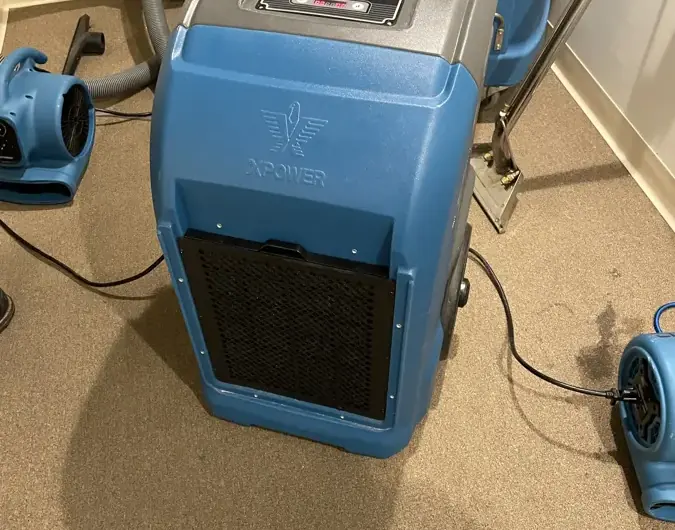
- Large dehumidifiers pull moisture from the air so it does not settle on cool surfaces.
- Equipment is rechecked each day and moved to where the readings stay high.
How extraction and drying work
Water leaves first. Pumps and extractors remove standing water from floors and carpet tile, then the crew checks the walls and ceilings with moisture meters.
A structural drying job follows, with air movers and dehumidifiers sized to the space.
- Moisture mapping shows the wet area and the dry area.
- Wet ceiling tiles, insulation and drywall that cannot dry are removed.
- Dehumidifiers dry the air in large open floors.
- Daily readings continue until materials reach their dry goal under the IICRC S500 standard.
Protecting inventory, records and equipment
Water hits contents as fast as it hits the building. A retailer or an office has paper, stock and equipment that cannot be replaced overnight.
A short plan helps a business move the right things first.
- Move records, laptops and servers first.
- Lift stock onto shelving or pallets away from wet floors.
- Photograph damaged stock before it is thrown away.
- Keep a list with quantities, because the insurer will ask for it.
Documentation, landlords and insurance
In multi tenant buildings, who pays for what depends on the lease and the policies. Neither the restoration team nor this post decides that.
Good records make the conversation simpler. Pleasanton's Pleasanton page lists the services the restoration team covers across the city, and the Dublin commercial water damage page covers the same work nearby.
- Save the building manager's written notice of the cause.
- Keep moisture logs and equipment records from the drying crew.
- Ask the insurer in writing what the policy requires before demolition.