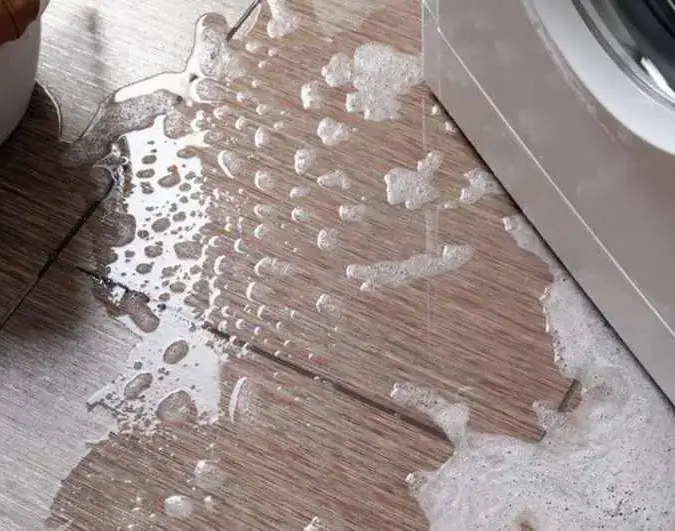
Many newer Dublin townhomes and stacked flats put the washer in an upstairs closet. When a hose or drain fails there, the water travels down through the floor into the ceiling and walls of the room below.
Key takeaways
- A washer leak upstairs is often found as a ceiling stain, a dripping light fixture or a soft spot in drywall in the room below.
- Shut the washer's supply valves first, then the main valve if the leak will not stop.
- In stacked flats and shared wall townhomes, the leak can reach a neighboring unit, so notify the neighbor and the building manager early.
- The restoration team opens wet drywall, extracts standing water and dries framing and cavities with meter checks.
- Photos taken before cleanup help every later conversation with an insurer or landlord.
Why East Dublin laundry leaks travel so far
East Dublin was built from the late 1990s on. Dublin Ranch, Positano, Fallon Village, Jordan Ranch and Wallis Ranch have a high share of townhomes, condos and stacked flats.
Many of these homes have the laundry closet on the upper floor, often next to bedrooms, with the water heater in the garage below.
That layout means water from a washer has a short path to a ceiling, a wall cavity or a neighbor's unit.
- Shared floors and ceilings let water spread to the unit below.
- Laundry closets have little floor area, so even a small leak finds the edge of the room quickly.
- A leak at the back of the machine can run for hours before anyone notices.
Where the water comes from
Most washer losses come from a short list of failures. Knowing them helps a homeowner spot trouble early.
- Supply hoses: a cracked or bulging hose, or a loose coupling at the wall valve.
- Drain hose: a hose that slips out of the standpipe during a spin cycle.
- Overflow: a clogged drain that backs up when the machine empties.
- Machine failure: a split tub seal or a pump leak behind the front panel.
- A drain pan that is cracked or missing under the washer.
What to do in the first minutes
Stop the water before anything else. A fast shutoff limits how far the water spreads.
Stop the source
Close both washer supply valves and unplug the machine if it is safe to reach the plug.
If a valve will not turn, close the unit's main supply valve.
Protect the room below
A sagging, bubbling or dripping ceiling holds water. Place a bucket under the drip and move furniture and electronics away.
Do not poke a bulging ceiling unless water is pouring out, and keep clear of any wet light fixture.
- Turn off power to a room where water is dripping from a fixture.
- Photograph the laundry closet, the ceiling and the walls before anything is moved.
- Tell the building manager or a neighbor if water may be reaching another unit.
Signs of a slow washer leak
Not every washer leak is a flood. A slow drip behind the machine can soak a subfloor for weeks before the first stain appears below.
A homeowner who knows the quiet signs can catch it while the damage is still small.
- A musty smell in the laundry closet or the room under it.
- A faint ring or yellow stain on the ceiling that grows after wash days.
- Paint that bubbles or peels on a wall near the laundry closet.
- Flooring in the closet that feels soft, spongy or cold.
- A drain pan under the washer that holds water even when the machine is off.
What the cleanup includes
A laundry leak cleanup follows the water from the closet down. The crew maps the wet area first, then removes the water, then dries it.
Wet ceiling drywall that is sagging or stained is opened so the cavity can dry. A ceiling leak water damage job often involves cutting a clean, square opening so the repair is simple later.
The goal is to dry the home in place when it can be dried, and to remove only what cannot recover.
- Moisture mapping: meters find the wet drywall, insulation and framing, including areas that look dry.
- Extraction: standing water on the laundry floor and in the lower room is pulled out first.
- Targeted opening: only wet drywall that will not dry is cut out.
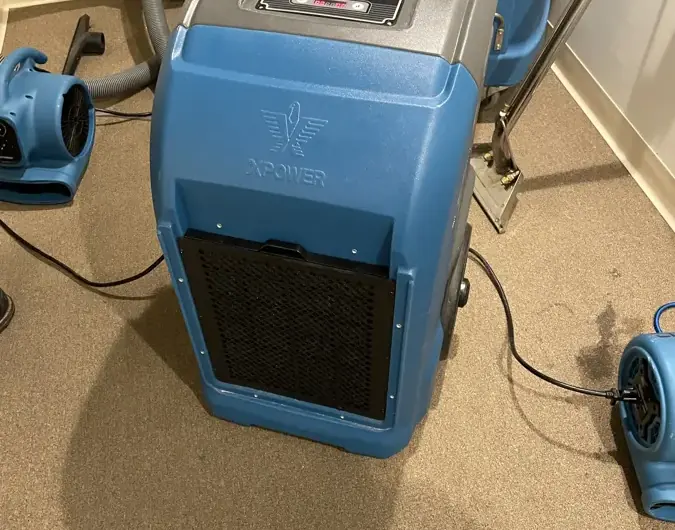
- Equipment: air movers and dehumidifiers run while readings are taken each day.
Shared walls and neighboring units
Water does not stop at a unit line on a floor plan. It follows pipes, framing and drywall seams into the next unit.
A condo and townhome water damage job maps each affected room, so both units are checked and documented.
- Check the wall that the laundry closet shares with a neighbor.
- Look at the ceiling and walls of the unit below for stains and soft spots.
- Ask the building manager who handles shared systems and who should be notified.
- Keep a log of dates, photos and who was told.
Why drying matters more than patching
Painting over a stain does not remove the water inside the wall. Trapped moisture can keep drywall soft and invite mold.
Drying to a measured goal, following the IICRC S500 standard, is what lets the repair that follows stay put.
For a bigger loss that reaches framing or subfloor, the structural drying page explains the equipment and readings.
Preventing the next laundry leak
Most washer losses start with a part that was already worn. A few minutes of attention on wash day lowers the risk.
None of this removes the risk entirely, but it shortens the time between a failure and its discovery.
- Replace old rubber supply hoses with braided hoses before they bulge or crack.
- Pull the washer out and look behind it once or twice a year.
- Shut the supply valves when leaving for a trip.
- Keep a drain pan under the machine, with a drain that is clear.
- Do not run the washer while nobody is home, especially in an upstairs closet.