Dublin goes months without rain, and then the water arrives all right away. Almost all of the year's rain falls from November to March, often in atmospheric river storms, and the first one tests every roof.
Key takeaways
- Heavy rain on flat or low slope townhome roofs finds weak flashing, seams and drains, and then shows up as a stain on a top floor ceiling.
- East Dublin has many townhomes, condos and stacked flats built from the late 1990s on, where roofs are shared and the owner may not control them.
- Catch the drip, move belongings away, and tell the building manager or HOA right away.
- The December 2022 to January 2023 storm series hit the Tri-Valley hard, so a roof that held in a light year can still fail in a wet one.
- The restoration team opens wet ceiling drywall, dries the cavity and insulation, and records moisture readings.
Why the first storm finds the weak spots
Dublin has a Mediterranean climate, so the roof sits dry for most of the year. Sun and heat dry out sealants and loosen flashing.
When the first atmospheric river arrives, water pushes into every gap right away. A seam that looked fine in September becomes a leak in November.
Dry golden hills in summer give way to storm runoff and heavy rain in winter, which is a hard test for any roof.
Wind can also drive rain sideways under edges and trim that a straight downpour would not reach.
- Dry summers shrink and crack sealants around vents and flashing.
- Leaves and dust collect in roof drains and gutters over the dry months.
- Heavy rain can overwhelm a clogged drain on a flat roof in minutes.
Low slope roofs on East Dublin townhomes
East Dublin, with Dublin Ranch, Positano, Fallon Village, Jordan Ranch and Wallis Ranch, has a high share of townhomes, condos and stacked flats. Many have flat or low slope roof areas.
A low slope roof sheds water slowly, so water sits longer against seams, penetrations and edges.
Owners cannot always see the roof from the ground, so the ceiling below is often the first warning.
- Water pools near drains and low spots, and presses on seams.
- Pipes, vents and skylights each add a place where flashing can fail.
- A leak often appears far from where the water actually entered, because it runs along framing.
Signs of a roof leak inside the home
A roof leak shows on the inside long before anyone climbs a ladder. The top floor is where it appears first.
A stain that dries and then returns after the next storm is a sign the leak is still open.
On the ceiling
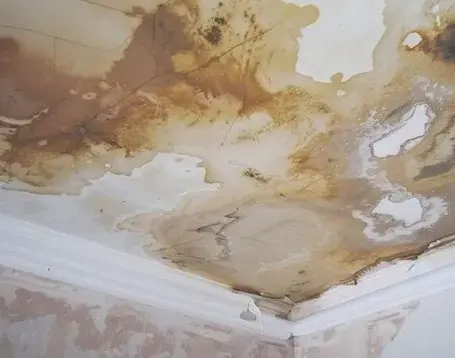
A ring, a yellow stain or a bulge in the drywall shows water collecting above.
- A brown or yellow ring that grows after each rain.
- A bubble or sag in the drywall that holds water.
- Peeling paint or a flaking texture near a corner or fixture.
Elsewhere in the room
Water can run down a wall or a light fixture, so the signs are not always on the ceiling.
- Drips from a ceiling fan or a recessed light.
- Dark streaks on the upper wall.
- A musty smell in a closet or hallway under the roof.
What to do when water is coming through
The goal is to limit the water inside and to start the right notices right away.
- Place a bucket under a drip and lay towels around it.
- Move furniture, bedding and electronics out of the area.
- Do not touch a wet light fixture, and switch off the circuit if water is dripping from it.
- If a ceiling bulges, make a small hole at the low point to drain it into a bucket, then stop.
- Photograph the stain, the drip and the weather before cleanup.

Shared roofs, HOAs and who to call
In a townhome or condo, the roof is often shared. A homeowner may not be able to repair it, and may not be the one who pays.
Tell the building manager or HOA right away, in writing, and keep a copy. The notice date can matter later.
- Ask who controls the roof and who has the repair contract.
- Report the leak with photos and the date of the storm.
- Tell the neighbor above or beside, because water can cross units.
- Ask the insurer how a shared roof loss is handled before repairs start.
How a wet ceiling is dried
The roof repair stops the water. The ceiling work removes what the water left behind.
A ceiling leak water damage job begins with moisture readings to find the full wet area, which is often larger than the visible stain.
The aim is to dry the wet cavity so the drywall patch that follows has a dry base.
- Meters and thermal checks map the wet drywall and insulation.
- Sagging or soaked drywall is cut out, and wet insulation is removed.
- Air movers and dehumidifiers dry the cavity and the framing.
- Readings are repeated until the materials reach their dry goal under the IICRC S500 standard.
Roof leaks, storms and flooding are different problems
A roof leak water damage job deals with water entering from above. Floodwater entering at ground level is a separate problem, handled under storm flood cleanup.
In a stacked building, a roof leak can also become a condo and townhome water damage case if it runs into several units.
- Roof leaks come from above and show in ceilings and upper walls.
- Storm flooding comes from the ground and shows at garage doors and low entries.
- Both can happen in the same atmospheric river.
Preparing before the next storm
A roof check before the first storm costs little compared with a ceiling repair. A homeowner or building manager can start with the basics.
The December 2022 to January 2023 storm series hit the Tri-Valley hard, which is a good reason to look early.
- Clear roof drains and gutters of leaves and debris.
- Ask the HOA when the roof was last inspected.
- Look at the ceiling after the first rain and mark any new stain with a date.
- Keep a bucket, towels and a flashlight near the top floor.